

Driven by industries such as 5G communication and automotive electronics, filters, as core components for signal processing, are developing towards miniaturization, high frequency, and mass production. Ceramic dielectric waveguides, with their excellent dielectric properties, thermal stability, and anti-interference capabilities, have become a core component of high-end filters. However, the high hardness and brittleness of ceramic materials make processing accuracy and efficiency a critical bottleneck limiting the mass production of filters. The innovative application of precision laser cutting technology has successfully overcome this challenge, providing core support for the efficient and precise processing of ceramic dielectric waveguides and enabling a qualitative leap in the scale of filter mass production.
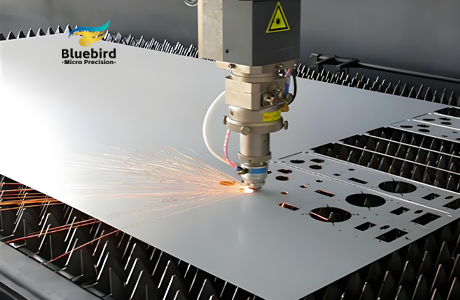
The reason why precision laser cutting technology is suitable for the mass production needs of ceramic dielectric waveguides lies in its dual advantages of non-contact processing and precise energy control. Unlike traditional mechanical processing, which easily leads to chipping and cracking of ceramics, the laser beam, focused into a micron-sized energy beam, can instantly act on the processing area of the ceramic material, achieving precise separation at the atomic level. The cutting edges are smooth and flat, eliminating the need for subsequent grinding and finishing processes.
In terms of mass production efficiency, precision laser cutting technology has achieved a breakthrough improvement. Traditional mechanical processing takes several minutes to process a single ceramic dielectric waveguide, while laser cutting equipment can achieve high-speed continuous processing, reducing the processing time per unit to tens of seconds, increasing production efficiency by more than 5 times. At the same time, laser cutting supports multi-station synchronous processing and automated assembly line integration, allowing for rapid switching of processing parameters for different specifications of waveguides through programming, without the need to change tools or molds, significantly reducing production line changeover time.
Today, precision laser cutting technology has become a core processing technology for filters, widely used in the production of ceramic dielectric waveguides in fields such as 5G communication, automotive radar, and satellite navigation. It not only solves the processing difficulties of hard and brittle ceramic materials but also, with its dual advantages of "high precision + high efficiency," promotes the filter industry towards large-scale and high-end upgrades. As laser technology develops towards ultrafast pulses and multi-beam collaboration, future ceramic dielectric waveguide processing will achieve breakthroughs in higher precision and faster speed, providing stronger manufacturing support for the innovative development of next-generation communication technologies.